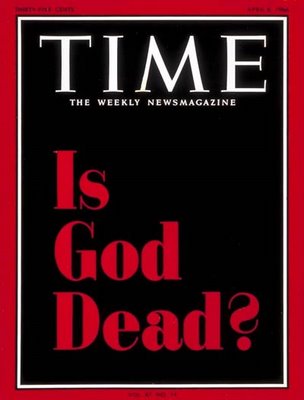
"Have you not heard of that madman who lit a lantern in the bright morning hours, ran to the market place, and cried incessantly: "I seek God! I seek God!"---As many of those who did not believe in God were standing around just then, he provoked much laughter. Has he got lost? asked one. Did he lose his way like a child? asked another. Or is he hiding? Is he afraid of us? Has he gone on a voyage? emigrated?---Thus they yelled and laughed.
The madman jumped into their midst and pierced them with his eyes. "Whither is God?" he cried; "I will tell you. We have killed him---you and I. All of us are his murderers. But how did we do this? How could we drink up the sea? Who gave us the sponge to wipe away the entire horizon? What were we doing when we unchained this earth from its sun? Whither is it moving now? Whither are we moving? Away from all suns? Are we not plunging continually? Backward, sideward, forward, in all directions? Is there still any up or down? Are we not straying, as through an infinite nothing? Do we not feel the breath of empty space? Has it not become colder? Is not night continually closing in on us? Do we not need to light lanterns in the morning? Do we hear nothing as yet of the noise of the gravediggers who are burying God? Do we smell nothing as yet of the divine decomposition? Gods, too, decompose. God is dead. God remains dead. And we have killed him."
Nietzsche wrote that in 1882 in his work, The Gay Science. (He wasn't a homosexual. Gay Science was a common term at the time for the skill required to create poetry. Nowadays we call it verbal-linguistic intelligence. You almost have to appreciate gay science for its simplicity).
From what I've gathered, Nietzsche wasn't really talking about an assault on the Creator himself but rather about a growing movement towards relativistic thinking that was occurring in the world at the time. Basically, he was saying if everything becomes relative then there can be no absolutes. Since God is the ultimate absolute then relativism destroys Him.
More than a hundred years later I think that the inherent conflict between relativism and absolutism, earthly knowledge vs. divine knowledge is alive and well. God hasn't died by any means but the speed at which information travels starts to make it easier to doubt in Him. For example, it's all well and good for us to accept our little personal tragedies with words like "God has a plan" but at least for me that blade gets a bit dulled when you know there are millions of people out there starving to death. And any time some scientist does something wacky like growing eyes on the wings of a fly the news spreads pretty quick.
That said, hopelessness and faithlessness does a person little help in this crazy world of ours. I think as leaders in public education we have a challenging job.
First we are not able to transparently teach our faith, the best we can do is exemplify it to others.
Second, as teachers of knowledge we represent peddlers selling slices of the apple from Eden. I never met an atheist until I got to college and started bumping into incredibly learned and intelligent people. It's obviously not a 100% connection but it seems to me that the smarter a person gets the better reasons they find for doubting in God. Yet our mission is to educate. It's not a total paradox, but there's at least a subtle one.
Third, the more intelligent we make people, the more scientists there will be out there doing things that start to make God look like a joke. In the same way that the incredible world of Star Trek in the 60s is basically reality today, science is making the incredible world of the divine described by prophets and scribes in 2000 BC seem a human reality in many ways.
So what are we to do? For my part, I fall back to a personal motto of mine: Don't despair.
Beyond that I return once again to the importance of imbedded character education in the curriculum, for example the profiles and attitudes that the Primary Years Programme (I wonder if the IBO considered that the extra "me" at the end of "program" there would come off as pompous in the States) of which I am a fan. Just like we need to teach students to be discriminating consumers of information, they must also become discriminating users of such information. We must also continue to lead by example. It's doubtful that we'll ever be able to teach Christianity in public schools (and for my part I think that's an important thing) but all the same we can demonstrate how Christians behave and hope that some of it rubs off.


No comments:
Post a Comment